




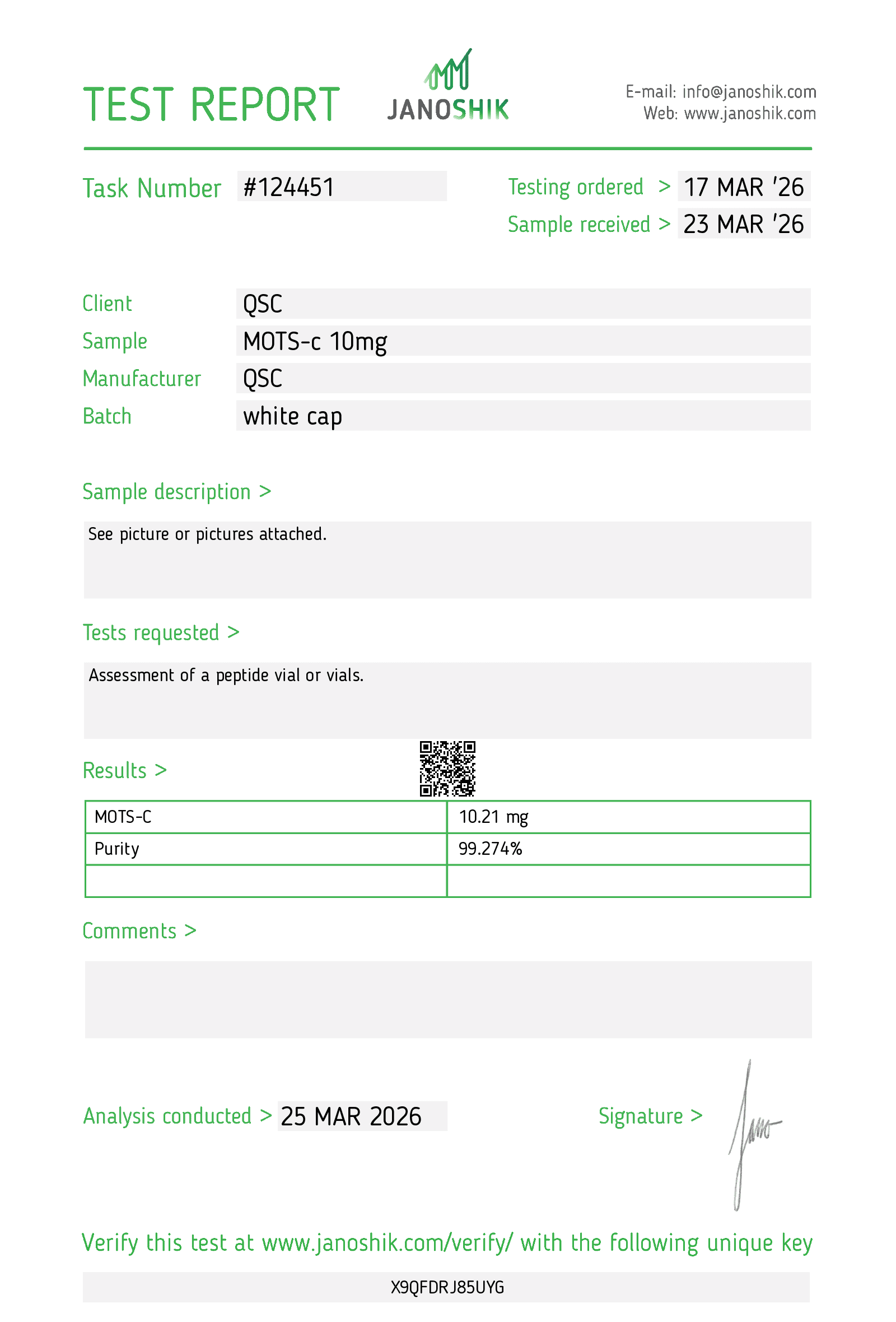
{“@context”: “https://schema.org”, “@type”: “FAQPage”, “mainEntity”: [{“@type”: “Question”, “name”: “How do I reconstitute MOTS-c?”, “acceptedAnswer”: {“@type”: “Answer”, “text”: “Add 1–2mL bacteriostatic water to the lyophilized MOTS-c vial. Swirl gently until dissolved. MOTS-c is a 16-amino acid peptide that dissolves readily to a clear, colourless solution.”}}, {“@type”: “Question”, “name”: “How should MOTS-c be stored?”, “acceptedAnswer”: {“@type”: “Answer”, “text”: “Store lyophilized at −20°C. Reconstituted: 2–8°C for up to 28 days. Avoid repeated freeze-thaw cycles and protect from UV light.”}}, {“@type”: “Question”, “name”: “What purity is QSC MOTS-c and how is it verified?”, “acceptedAnswer”: {“@type”: “Answer”, “text”: “QSC MOTS-c is ≥99% HPLC pure with MS-confirmed 16-amino acid sequence on every batch. COA is published on the product page and verifiable at verify.janoshik.com.”}}]}
What is MOTS-c?
MOTS-c (Mitochondria-derived peptide (mitochondrial 12S rRNA-encoded)) is a 16-amino acid mitochondria-encoded peptide. Mitochondria-derived peptide encoded by the 12S rRNA gene — translocates to the nucleus under metabolic stress to regulate AMPK and folate-methionine cycle activity. Declines with age. Extends lifespan in aged male mice, improves insulin sensitivity, exercise capacity, and thermogenic response to cold stress.
Research Applications
Retrograde Signalling
Mitochondria-to-nucleus communication under metabolic stress
AMPK Activation
Energy sensor activation, cellular fuel switch, autophagy
Insulin Sensitivity
Glucose uptake, GLUT4 translocation, insulin resistance models
Exercise & Metabolism
VO2 max, muscle metabolism, endurance capacity research
Longevity Biology
Age-related decline, mitokine signalling, lifespan extension
Quick Specs
| Form | Lyophilized powder |
| Purity | ≥99% by HPLC — every batch |
| CAS Number | Not publicly standardized |
| Molecular Formula | Sequence-specific (16-amino-acid mitochondrial-derived peptide) |
| Peptide Type | Mitochondria-Derived Peptide / Metabolic Regulator |
| Identity | MS molecular weight confirmed — every batch |
| COA | Janoshik-independent, publicly verifiable |
| Manufacture | In-house Fmoc SPPS — Qingdao, China |
| Storage | -20°C sealed | 2–8°C reconstituted (2–4 weeks) |
| Shelf Life | 24 months unopened |



Reviews
Clear filtersThere are no reviews yet.